
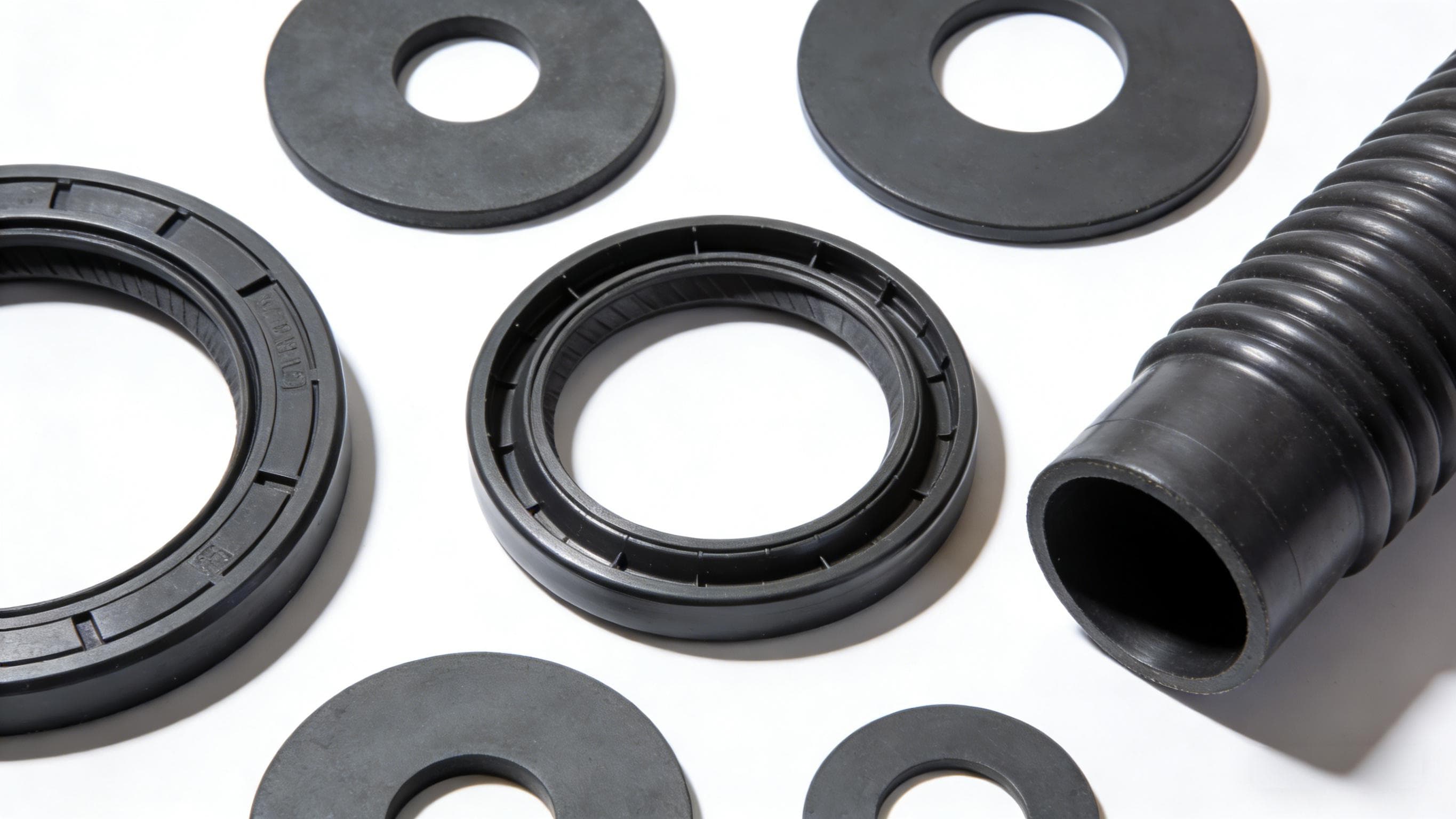
Rubber compounds rely on silicon chemistry in two quite different ways. In organic rubber — natural rubber, SBR, EPDM — silanes are coupling agents that bond reinforcing fillers such as silica into the polymer network. In silicone rubber, silicon is the polymer itself, and silanes, siloxanes and resins decide how it cures and how strong it becomes.
Coupling silica into organic rubber
Silica reinforces rubber well but does not bond to it on its own. Polysulfide silanes react with the silica surface during mixing and with the rubber during vulcanisation, tying the two together. In tyre treads this is what allows silica to lower rolling resistance while keeping wear resistance. Disulfide grades are less prone to scorch during mixing; mercapto silanes are more reactive still; carbon-black-supported grades are solids that are easier to dose.
Curing silicone rubber
Condensation cure. One-part RTV silicone sealants are built on hydroxyl-terminated polydimethylsiloxane and cure with moisture through a crosslinker: acetoxy silanes cure fast and release acetic acid; oxime silanes cure neutral; alkoxy silanes such as methyltrimethoxysilane release alcohol and are the least corrosive.
Addition cure. Liquid and high-consistency silicone rubbers based on vinyl-terminated polymers cure through platinum-catalysed reaction with Si–H crosslinkers, without by-products. Vinyl MQ resin reinforces these systems while keeping them transparent.
Processing aids
Fumed silica makes silicone rubber strong but can stiffen a stored compound — "crepe hardening". Structure-control agents such as hexamethyldisilazane, diphenylsilanediol and low-viscosity silanol fluids treat the filler during compounding and keep the rubber workable. Octaphenylcyclotetrasiloxane is the source of phenyl units for low-temperature and radiation-resistant phenyl silicone rubber.
Choosing
- Organic rubber with silica: tetrasulfide for general use, disulfide where scorch safety matters, mercapto for maximum reactivity.
- RTV sealant: choose the crosslinker by the cure by-product the substrate tolerates — acid, oxime or alcohol.
- Transparent or high-strength silicone rubber: reinforce with vinyl MQ resin.
For a recommendation for your formulation, a COA, an SDS or a quotation, contact our technical sales team.
İlgili Ürünler
Silanes
SF-S069 Bis-[3-(triethoxysilyl)-propyl]-tetrasulfide
CAS 40372-72-3
Bis[3-(triethoxysilyl)propyl]tetrasulfide; Silane coupler KH-858; Si-69 Silane coupling agent, CAS No. 40372-72-3
Silanes
SF-S075 Bis-[3-(triethoxysilyl)-propyl]-disulfide
CAS 56706-10-6
Bis(triethoxysilylpropyl) disulfide ,CAS No. 56706-10-6
Silanes
SF-S69C Mixture of Bis-[3-(triethoxysilyl)-propyl]-tetrasulfide and Carbon Black
Mixture of Bis-[3-(triethoxysilyl)-propyl]-tetrasulfide and Carbon Black; The mixture of Bis-[3-(triethoxysilyl)-propyl]-tetrasulfide (50%) and Carbon Black (50%)
Silanes
SF-S591 3-Mercaptopropyltriethoxysilane
CAS 14814-09-6
γ-Mercaptopropyltriethoxysilane, CAS No.14814-09-6
Silanes
SF-SMTA Triacetoxy(methyl)silane
CAS 4253-34-3
Methyltriacetoxysilane, CAS No. 4253-34-3
Silanes
SF-SMOS Methyltris(methylethylketoxime)silane
CAS 22984-54-9
Methyltris(methylethylketoxime)silane, CAS No. 22984-54-9
Silanes
SF-S131 Methyltrimethoxysilane (MTMS)
CAS 1185-55-3
Methyltrimethoxysilane; MTMS, CAS No.1185-55-3
Silanes
SF-S171 Vinyltrimethoxysilane, VTMO
CAS 2768-02-7
Vinyltrimethoxysilane; VTMO CAS No. 2768-02-7
Silicone Oils
SF-QT200 OH end-blocked polydimethylsiloxane
CAS 70131-67-8
Silanol fluid; silicone fluid; OH end-blocked polydimethylsiloxane; 107 polymer; Hydroxy silicone oil CAS No. 70131-67-8
Silicone Oils
SF-VS200 Vinyl terminated silicone oil
CAS 68083-19-2
Vinyl terminated silicone oil; vinyl-terminated silicone oil; vinyl silicone oil CAS No.: 68083-19-2
MQ Silicone Resins
SF-101 Methylvinyl MQ silicone resins
CAS 68988-89-6
Methylvinyl MQ silicone resin
Siloxanes & Silazanes
SF-SN62 Hexamethyldisilazane
CAS 999-97-3
Hexamethyldisilazane; 1,1,1,3,3,3-hexamethyldisilazane; HMDS CAS No. 999-97-3
Silanes
SF-S222 diphenylsilanediol
CAS 947-42-2
Diphenyldihydroxysilane; diphenylsilanediol CAS No. 947-42-2
Siloxanes & Silazanes
SF-SO84 Octaphenylcyclotetrasiloxane
CAS 546-56-5
Octaphenylcyclotetrasiloxane; OTPCS CAS No. 546-56-5